
Contactless Health Monitoring Through Wi-Fi: How Radio Signals Detect Movement, Breathing and Falls
Wi-Fi is normally associated with internet access, yet the radio signals travelling between wireless devices also carry information about what is happening inside a room. A person walking across a living room, turning in bed or simply breathing changes the way those signals travel, reflect and arrive at a receiver. Researchers can analyse these small variations to recognise movement and, under suitable conditions, estimate breathing patterns or detect events such as a fall. By 2026, Wi-Fi sensing has developed from a largely experimental idea into a recognised field of wireless research supported by a dedicated IEEE standard and increasingly realistic home trials. It remains different from conventional medical monitoring: the technology does not directly measure the body in the same way as an ECG electrode, pulse oximeter or respiratory belt. Instead, it observes how the human body changes the surrounding radio environment. This makes contactless monitoring attractive for homes, assisted-living settings and other situations where people may not want to wear a sensor continuously, but it also means accuracy depends heavily on the room, equipment, number of people present and the particular health measurement being attempted.
How Wi-Fi Becomes a Contactless Health Sensor
Every Wi-Fi transmission travels from a transmitter to a receiver through more than one route. Some of the radio energy follows a relatively direct path, while other parts reflect from walls, furniture, floors and people before reaching the receiving device. These reflections normally happen unnoticed because Wi-Fi equipment is designed to reconstruct the transmitted data despite them. For sensing, however, the changes are useful. When a person moves, the arrangement of reflected paths changes. A hand movement can cause a small variation; walking produces a longer and more pronounced sequence; sitting down, standing up and falling each create their own time-dependent patterns. Even when someone is sitting or lying still, the slight expansion and contraction of the chest during breathing can alter reflected radio waves enough for sensitive equipment and suitable processing methods to pick up a repeating rhythm.
A particularly important source of information is Channel State Information, usually shortened to CSI. It describes how the wireless channel affects different parts of a Wi-Fi transmission between the transmitting and receiving devices. A conventional signal-strength reading gives only a broad indication of how strong a connection is. CSI contains finer information about how individual parts of the signal have changed in strength and timing as they travelled through the room. Researchers can therefore treat successive CSI measurements almost like a changing radio fingerprint of the environment. If the furniture stays still but a person starts walking, breathing more quickly or changing position, corresponding changes appear in that fingerprint. Software then removes unwanted noise and looks for patterns associated with the activity it has been designed to recognise.
This approach does not turn a router into a medical scanner, and a standard household router cannot necessarily perform advanced health sensing simply because Wi-Fi is enabled. The hardware must expose suitable signal measurements, and software needs to interpret them. Development has nevertheless moved towards greater standardisation. IEEE 802.11bf-2025, formally titled Enhancements for Wireless LAN Sensing, introduced defined mechanisms that allow compatible wireless devices to support sensing measurements as part of Wi-Fi operation. The amendment covers sensing functions across relevant Wi-Fi frequency ranges and provides methods for devices to indicate sensing capabilities, request measurements and exchange sensing information. This matters because earlier research often depended on particular network cards, experimental firmware or hardware-specific techniques. Standardised sensing support can make future systems easier to develop across different devices, although the existence of the standard does not itself make a Wi-Fi product a medically validated health monitor.
From Radio Reflections to Recognisable Human Patterns
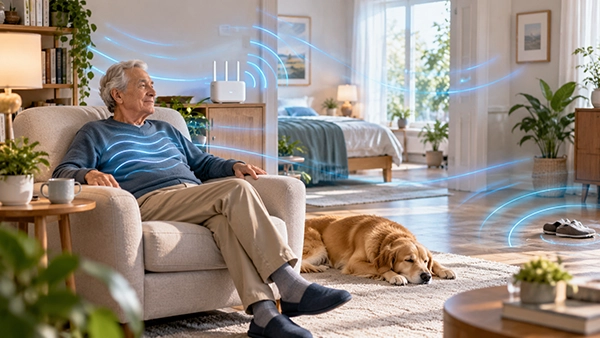
The easiest activity for Wi-Fi sensing to recognise is usually relatively large movement. Walking through a room disturbs many reflected signal paths at once, producing changes that are much stronger than the background variation found in an empty room. Systems can be trained to distinguish periods of activity from inactivity and, in more advanced cases, separate actions such as walking, sitting, standing or lying down. This creates potential uses beyond simple presence detection. A care system might track changes in normal household movement, for example, without recording video. A long period of unexpected inactivity could be treated as a reason to check on someone, while repeated movement during the night might form part of a broader picture of sleep behaviour. The signal does not provide a conventional photograph of the person; it provides a sequence of measurements from which behaviour is inferred.
Breathing is harder because the physical movement is much smaller. During quiet respiration, the chest and abdomen move only slightly, so the useful radio variation can easily be mixed with changes caused by another person, a fan, nearby movement or a change in body position. Researchers therefore filter the received data and search for slow, repeating fluctuations that match plausible breathing rhythms. A 2024 study using low-cost ESP32 hardware showed that CSI from inexpensive Wi-Fi equipment could be used to monitor sleeping respiratory rate in a controlled setting. Other research has demonstrated breathing monitoring with commercial wireless equipment rather than specialised medical sensors. These results are important because they show that the basic effect is measurable with relatively accessible hardware, but results obtained in a quiet experiment cannot automatically be transferred to every bedroom, care home or hospital room.
Fall detection relies on another type of pattern. A fall can produce rapid body movement followed by a strong change in position and, in some cases, a period of limited movement afterwards. Machine-learning systems can be trained on CSI recordings of falls and everyday activities so that they learn the difference between a genuine fall-like event and actions such as sitting quickly, bending down or lying on a bed. Published experiments have reported high classification accuracy under their particular test conditions, including research using commodity Wi-Fi hardware. The important qualification is that accuracy figures belong to the tested participants, rooms, equipment and activity set. In a real home, a reliable alert system has to cope with furniture, pets, visitors, wireless interference and people moving in ways that were not present in the original training data. Avoiding false alarms is therefore as important as recognising the fall itself.
What Wi-Fi Can Monitor in the Home in 2026
Movement sensing is currently one of the more practical applications because ordinary human activity causes relatively clear changes in wireless propagation. A sensing system can potentially determine that somebody is present, recognise motion in part of a room or classify selected activities without asking the person to carry a phone or wear a wrist device. For older adults, this could support less intrusive forms of home monitoring. Instead of collecting continuous camera footage, a system might use radio measurements to identify a significant change in routine, prolonged absence of movement or a possible fall. Similar techniques are studied for gait recognition and activity monitoring. However, the useful output depends on what the system has actually been trained and validated to identify. Detecting movement does not automatically reveal why the person moved differently, and a change in daily activity is not by itself evidence of illness.
Respiratory monitoring is one of the most closely studied health applications because breathing creates a regular physical movement that radio sensing can sometimes isolate. Possible uses include estimating breaths per minute during rest or sleep and following changes in the respiratory pattern over time. Research has also considered unusual pauses or changing respiration, although recognising clinically significant events is more demanding than simply estimating a breathing rate. The difficulty increases substantially when several people are present because their reflected signals combine. A 2025 study on multi-person respiration monitoring used commodity Wi-Fi devices and a method designed to separate mixed respiratory waveforms. Work of this kind shows that researchers are moving beyond the simple case of one stationary person in an otherwise quiet room, but multi-person monitoring remains one of the recognised challenges for Wi-Fi-based health sensing in 2026.
Heart-rate sensing is possible in research settings but remains considerably more difficult. A heartbeat produces much smaller body movement than normal breathing, making the relevant signal more vulnerable to noise and ordinary environmental change. A 2025 University of Edinburgh study illustrates the difference between promising laboratory results and real homes. Researchers tested an unobtrusive Wi-Fi CSI system with volunteers aged 60 and over in different home environments. For the paired respiratory measurements reported in the study, the system produced a mean absolute error of 1.97 breaths per minute and an accuracy measure of 89.25% compared with a respiratory belt. The authors found respiratory measurements encouraging but reported greater variability in heart-rate estimation. The study was also small, so the researchers stressed the need for more extensive testing. This is a useful indication of the technology’s current position: breathing can be measurable without contact, but realistic healthcare use requires much more than a good laboratory demonstration.
Breathing, Heart Rate and Fall Detection in Practice
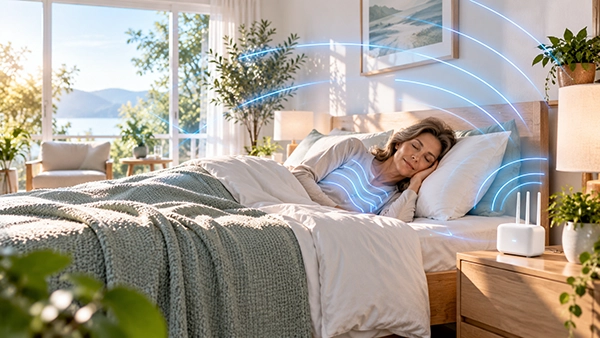
A major benefit of radio-based sensing is that the person being monitored does not necessarily need to remember to charge, attach or wear another device. That matters particularly during sleep and long-term home monitoring. Wearables can provide detailed measurements, but they only work when they are worn correctly. Cameras can observe movement continuously but may be unacceptable in bedrooms, bathrooms or private living areas. Wi-Fi sensing occupies a different position. It can operate without producing conventional images and can sometimes reuse wireless infrastructure already needed for communications. It may therefore complement other sensors rather than replace them. A home-care system could, for instance, combine a contactless movement or fall signal with an optional wearable, a door sensor or a user confirmation before escalating an alert. Using several types of evidence can reduce the risk of treating one unusual radio pattern as a medical emergency.
The same principle applies to respiratory information. A series of breathing-rate estimates may be more useful than a single isolated reading because trends can show whether a person’s normal pattern has changed. Contactless sensing could be valuable when repeated measurements are desired without disturbing sleep or requiring someone to attach a sensor every night. However, interpretation has to remain cautious. Faster breathing can occur for many reasons, including physical activity, stress, room temperature and illness. A Wi-Fi system recognising an altered respiratory pattern cannot determine the medical cause from radio reflections alone. It may provide information that prompts another measurement or professional assessment, but the sensing result has to be considered alongside symptoms, medical history and validated clinical measurements when health decisions are involved.
Fall alerts have a similarly clear but limited role. The objective is not to diagnose an injury; it is to recognise a sequence of movement that resembles a fall and trigger an appropriate response. A useful system must distinguish falls from daily activities while also determining what happens immediately afterwards. Someone dropping an object should not trigger the same response as a person collapsing and remaining motionless. Some research therefore combines the abrupt motion associated with the fall with subsequent activity or inactivity. Experimental Wi-Fi fall-detection systems have produced strong results, and published work in 2024 reported successful classification using commodity hardware and deep-learning methods. Those figures show technical feasibility, but real deployment requires testing with more people, varied body types, different room layouts and genuine everyday behaviour. Falls are comparatively rare events, so collecting realistic data without putting participants at risk is itself a significant challenge.
Limits, Privacy and the Route to Reliable Health Use
The room is one of the biggest variables in Wi-Fi sensing. Radio waves bounce from walls, cupboards, doors, televisions and many other objects. Moving a chair, opening a door or changing the position of the transmitting device can alter the measured channel. Research published in 2025 specifically examined how CSI-based sensing performs over time and warned that environmental and temporal changes can affect the ability of models to generalise beyond the conditions in which they were trained. This is why impressive accuracy in one experimental room should not be interpreted as universal performance. A practical system needs to remain dependable after furniture is rearranged, neighbouring wireless traffic changes or a new device is added to the home. It may need automatic recalibration or models trained across many different environments rather than one fixed layout.
Multiple occupants create another challenge. If one person is breathing while another walks across the room, the larger movement may temporarily dominate the signal. Two people with similar respiratory rates can also be difficult to separate because the receiver observes a mixture of reflections. Pets, robotic vacuum cleaners and moving curtains can add further variation. Newer research uses multiple antennas, multiple wireless links and signal-separation techniques to distinguish simultaneous sources of motion, but the complexity rises quickly. The required level of reliability also depends on the task. It may be acceptable for a smart-home feature to occasionally miss a minor movement; it is far more serious for a safety system to miss a real fall or generate frequent emergency alerts when nobody is in danger. Health-related uses therefore require evaluation against the consequences of both missed detections and false alarms.
There is also a fundamental distinction between sensing capability and medical evidence. A Wi-Fi system can estimate a physical pattern without proving that the estimate is accurate enough for diagnosis or treatment decisions. Clinical use requires appropriate validation for the intended purpose and, where applicable, compliance with medical-device requirements in the relevant country. Researchers increasingly test systems outside controlled laboratories, which is an important step because real homes expose weaknesses that laboratory trials can hide. The 2025 Edinburgh home study, for example, reported lower respiratory accuracy than earlier controlled measurements. Findings of this kind are valuable because they show where development is still needed. In 2026, Wi-Fi sensing is best understood as a rapidly advancing contactless sensing method with credible health and care applications, rather than a universal substitute for established medical instruments.
What Has to Improve Before Wi-Fi Sensing Becomes Routine
The first requirement is stronger real-world validation. Systems need to be tested across different ages, body sizes, homes, building materials, sleeping positions and patterns of daily life. They also need to maintain performance over weeks or months rather than a short experimental session. Respiratory sensing must be assessed when people change position or another person enters the room; fall detection has to distinguish a wide range of ordinary rapid movements from actual falls. Developers also need to know how often the system produces false alerts, not just how accurately it classifies carefully selected recordings. In health monitoring, a model that performs well on a research dataset may still be unsuitable for everyday use if it needs frequent recalibration or if its errors occur during precisely the situations where reliable detection matters most.
Privacy will require equal attention. Wi-Fi sensing avoids conventional video, but that does not mean the information is automatically non-sensitive. Radio measurements can reveal presence, movement patterns and aspects of behaviour, and research published in 2025 has specifically examined the risk of unauthorised CSI-based sensing and methods for protecting wireless environments against it. A responsible system should make sensing visible to users, restrict access to collected information and define how long data are retained. Consent becomes particularly important in shared homes and care settings because one installed sensing device may observe radio changes caused by several people. Future equipment therefore needs security controls designed not only to protect internet traffic but also to prevent sensing functions from being activated or queried by parties that do not have permission.
IEEE 802.11bf-2025 gives the field a more consistent technical foundation, but standards, algorithms and health validation solve different parts of the problem. A wireless standard can establish how compatible devices obtain and exchange sensing measurements; it cannot decide whether a particular breathing estimate is medically reliable or whether a fall alert should automatically contact emergency services. Those decisions require carefully designed products, testing and clear rules about how information is used. The most realistic role for contactless Wi-Fi health sensing in the near term is therefore supportive: detecting movement, helping identify unusual inactivity, providing respiratory trends or adding another source of evidence to a fall-alert system. As hardware and algorithms improve, the technology may become less dependent on controlled room conditions. Its long-term value will depend not on detecting the largest possible number of behaviours, but on producing a smaller set of measurements consistently, securely and reliably enough to be genuinely useful in everyday care.