
Small Modular Reactors (SMRs): Passive Safety Systems and the Manufacturing Cycle
Small modular reactors are often discussed as a way to make nuclear new-build more predictable: smaller units, repeatable designs, and a shift from bespoke construction to industrial manufacturing. By 2026, the conversation has become more practical and less theoretical, because several national programmes have moved from concept selection into licensing decisions and early construction activity. That has forced developers and regulators to focus on two make-or-break areas: whether passive safety features genuinely reduce risk and complexity, and whether a factory-led production model can deliver consistent quality at scale.
Passive safety in SMRs: what it means in practice
“Passive safety” is not a slogan; it is a design approach that aims to keep the reactor in a safe state using natural forces such as gravity, natural circulation, and stored energy, rather than relying mainly on powered pumps, active valves, and operator actions. In conventional reactors, safety systems may still be robust, but they can involve extensive redundancy, complex piping, and large numbers of components. SMR designers try to simplify the safety case by reducing component count and placing more emphasis on inherent physical behaviour during abnormal events.
A typical passive concept focuses on three functions: shutting the reactor down, removing decay heat, and maintaining containment integrity. Shutdown is usually handled by control rods that insert by gravity or spring force. Heat removal is often achieved through natural circulation loops, passive heat exchangers, or long-duration cooling pathways that do not require external power for a defined period. Containment is addressed through robust pressure boundaries and strategies that prevent overheating, hydrogen build-up, or loss of coolant from escalating into severe fuel damage.
What matters for real-world deployment is not just whether these features exist, but whether they are testable, inspectable, and credible under regulatory scrutiny. Passive systems must still be proven through analysis, integral testing, and operating experience where available. They also need to be designed for maintenance: “passive” does not mean “maintenance-free”. Valves, heat exchangers, and sensors still age, and the plant still needs periodic verification that passive pathways are available when required.
How passive features change the safety case and plant layout
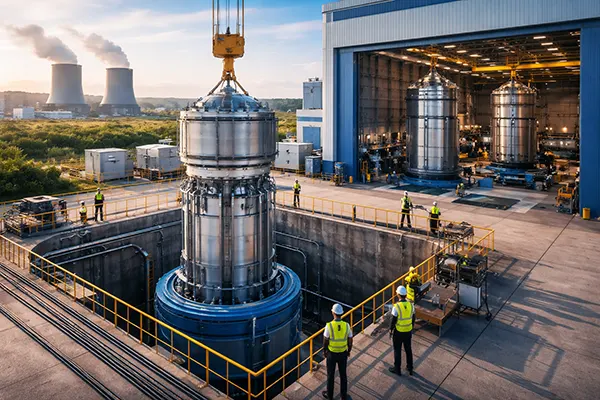
One practical benefit of passive safety is the potential to reduce the number of safety-class components and the amount of safety-related cabling and piping. When fewer active components are required to manage transients, the plant layout can become more compact and easier to standardise. In several SMR concepts, major primary-system components are placed within a single reactor module, which reduces the number of large-bore penetrations and external loops that can be sources of leakage or complicated maintenance.
Another important shift is how designers treat “time”. Passive safety is often described in terms of coping time without off-site power or operator intervention. Instead of assuming a rapid response from multiple active systems, the design aims to remain within safe thermal and pressure limits for extended periods, giving operators more margin. That margin can be valuable in rare, high-consequence scenarios, but it must be translated into concrete acceptance criteria: temperatures, pressures, and coolant inventory over time, across a range of initiating events.
Finally, passive safety influences the choice of materials and inspection regimes. If the reactor relies on natural circulation and heat transfer through specific pathways, those heat transfer surfaces and flow routes become safety-significant. That can drive conservative material selection, higher-quality welding requirements, and more frequent nondestructive examination. In other words, passive safety can reduce operational complexity during accidents, but it can increase the emphasis on manufacturing quality and lifetime integrity management.
From workshop to site: the SMR manufacturing and build cycle
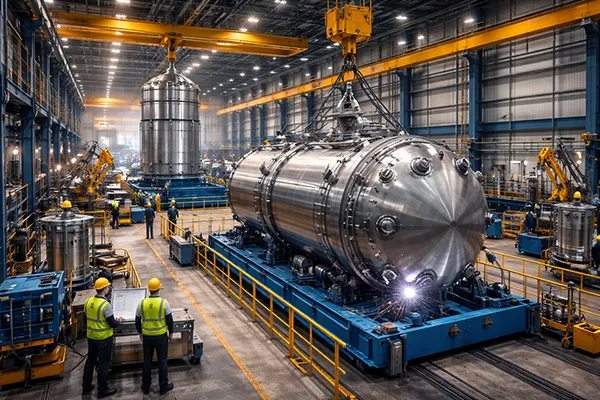
The promise of SMRs is not merely a smaller reactor; it is a different production philosophy. Instead of treating each plant as a one-off megaproject, developers aim to manufacture large portions of the plant as repeatable modules in controlled factory conditions. The best-known rationale is quality and schedule: factories can support consistent processes, trained teams repeating the same tasks, and better environmental control for welding, machining, and assembly. That is difficult to replicate on a weather-exposed construction site.
In a realistic build cycle, standardisation starts long before steel is cut. The design must be “frozen” enough for suppliers to invest in tooling, qualification, and long-lead procurement. The regulator must also be comfortable that the as-built product will match the analysed design, which pushes manufacturers towards tight configuration control and robust documentation. For SMRs, this includes manufacturing records, traceability of materials, digital quality dossiers, and clear hold points for inspections and acceptance testing.
Transport and logistics are not an afterthought; they shape what “modular” can mean. Module size, weight, and geometry determine whether components can travel by road, rail, barge, or a combination. Choices made for factory efficiency can be constrained by bridge clearances, port capacity, and the availability of heavy-lift cranes at the site. By 2026, the most credible programmes are those that treat logistics as an engineering discipline, not a procurement detail.
Where passive safety meets manufacturing reality
Passive safety features can be deeply intertwined with manufacturing choices. If a design uses an integral reactor vessel with internal steam generators and coolant pumps (or pump alternatives), the quality of vessel fabrication and internal assembly becomes central to the safety case. A defect that might be manageable in a highly accessible, loop-based layout could be far more disruptive in a compact, integrated module, simply because access for repair is more limited once the module is assembled.
That is why advanced manufacturing practices matter: high-spec machining, automated welding where appropriate, rigorous heat treatment control, and repeatable inspection methods. Factories can also support “test before ship” approaches, such as pressure testing, leak testing, and functional checks of instrumentation and valve actuation. The closer a module can get to a verified state before it reaches the site, the less commissioning risk remains in the field.
On-site work still exists, and it remains substantial. Foundations, civil works, electrical interconnections, balance-of-plant systems, and site-specific integration do not disappear. The realistic advantage is not that the site becomes simple, but that the most complex nuclear-grade fabrication steps move to environments where quality is easier to control. In that sense, SMRs shift project risk from field construction variability towards factory throughput, supply chain discipline, and configuration management.
Fuel cycle and lifecycle: the often-missed constraint
An SMR is only as deployable as its fuel and lifecycle support. Many near-term water-cooled SMR concepts use conventional low-enriched uranium (LEU) similar to today’s large reactors, which fits within existing enrichment and fuel fabrication capabilities. However, some advanced designs rely on higher-assay low-enriched uranium (HALEU) to achieve longer cycles, higher burnup, or compact cores. In 2026, HALEU availability and conversion/fabrication capacity remain a key scheduling risk for those designs, independent of how elegant the reactor engineering looks.
The “production cycle” therefore includes fuel contracting, qualification of fuel forms, fabrication lead times, and regulatory acceptance of fuel performance models. Utilities and developers also need clarity on refuelling strategy: on-line refuelling versus batch refuelling, outage duration assumptions, and the staffing and security model for fuel handling. Even with smaller cores, nuclear fuel management remains a disciplined industrial process with long lead times and tight controls.
Beyond fuel, the lifecycle includes spent fuel storage, waste classification, transport readiness, and eventual decommissioning planning. The physical size of an SMR does not automatically make waste issues trivial. What can improve is predictability: if units are standardised and built in fleets, operators can plan common spare parts, common maintenance intervals, and common end-of-life approaches. But those benefits only appear when the “fleet mindset” is real, not when projects are isolated demonstrations.
What “end-to-end” looks like for a serious SMR programme
An end-to-end programme starts with a licensing strategy that matches the deployment model. If the goal is repeatable build-out, the design needs a stable reference configuration and a process for controlled updates. Regulators and operators will expect evidence that changes are tracked, tested, and incorporated without undermining the safety case. This is where strong engineering governance and supplier qualification become as important as reactor physics.
Next comes the industrial base: qualified foundries, forge capacity where needed, nuclear-grade welding and inspection capability, and the workforce to operate those lines for years. A single unit can be built with heroic effort; a fleet requires normalised processes. In practical terms, the difference is whether manufacturing can hit consistent yield, keep rework low, and maintain documentation quality without slowing the line to a crawl.
Finally, lifecycle credibility is judged by what happens after first criticality. Operators need training pipelines, spare parts strategies, cybersecurity and physical protection regimes, and a mature approach to ageing management. If passive safety reduces the number of active emergency systems, it does not eliminate operational responsibility; it shifts it towards verifying passive pathways and maintaining structural integrity. By 2026, the programmes most likely to scale are those that treat safety, manufacturing, fuel, and operations as one continuous system rather than separate workstreams.