

Orbital Data Centres: Why Companies Are Moving Computing into Space
Orbital data centres have shifted from a speculative idea to an early engineering market. By 2026, several organisations have placed capable computing hardware in low Earth orbit, tested artificial intelligence workloads and connected orbital processors to high-speed satellite links. These systems are still tiny compared with terrestrial facilities, and no company is operating a vast server complex above Earth. The practical goal is narrower: to process information closer to satellites, space stations and future lunar missions, then send useful results rather than enormous volumes of raw data to the ground. Supporters also point to solar power, reduced demand for cooling water and fewer land constraints. The case is not settled, however. Launch emissions, radiation, heat removal, maintenance and communications remain serious obstacles. Orbital computing therefore matters less as a replacement for every terrestrial server room and more as a new layer of infrastructure for tasks that already begin in space.
What an Orbital Data Centre Actually Does
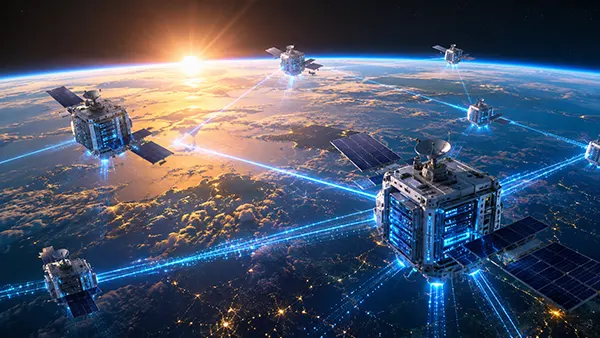
The term “orbital data centre” can create the wrong picture. In 2026, it usually means a compact computing and storage unit carried by a satellite or installed on a space station, not a building-sized facility filled with server racks. Such a unit may run software used for image analysis, artificial intelligence, data compression, cybersecurity or mission control. More advanced designs connect several units through radio or laser links, allowing them to share workloads and move information between spacecraft. The central idea is familiar from edge computing on Earth: deal with data close to the place where it is created. The difference is that the “edge” may be hundreds of kilometres above the ground and exposed to vacuum, radiation and extreme temperature changes.
Many modern satellites produce far more information than they can immediately send to Earth. High-resolution cameras, radar instruments, weather sensors and scientific payloads can generate large files during every pass. A conventional satellite stores that material until it reaches a suitable ground station, then transmits as much as the available contact time and bandwidth permit. An orbital computing node can review the information first. It might remove cloud-covered images, compress useful scenes, recognise a wildfire, identify a damaged road or flag an unusual vessel movement. Instead of transmitting every pixel, the spacecraft can send a smaller set of selected images, coordinates or alerts. This saves scarce downlink capacity and can shorten the time between observation and action.
The strongest early demand is therefore likely to come from organisations already working in space. Earth-observation operators can use local processing to deliver faster alerts. Communications companies can analyse network traffic and manage routing in orbit. Space stations can store experiment results and run software without relying on constant contact with terrestrial servers. Lunar missions will need even greater independence because every command and response must travel much farther. For these users, orbital computing is not a dramatic relocation of ordinary internet services. It is a practical way to make spacecraft less dependent on a continuous connection to Earth and to use communications links for the information that matters most.
Why Processing Data Near Satellites Matters
Downlink capacity is one of the least visible limits in the space economy. A satellite may collect information quickly, but it can only transmit when it has a working route to a ground antenna or relay network. Radio spectrum is limited, ground-station schedules are shared and weather can disrupt optical links. Sending raw data also consumes power that might otherwise support instruments or extend mission operations. Local processing changes this balance. A spacecraft can sort, rank and package its own output before transmission, reducing the amount of data that must cross the space-to-ground connection. The benefit becomes larger as sensors improve because better instruments often create more data, not less.
Speed is especially important when information loses value quickly. A flood map delivered several hours earlier can help emergency teams choose passable roads. A wildfire alert created in orbit can direct another satellite to take a closer image before smoke spreads. Maritime monitoring can highlight suspicious movement while a vessel is still within a relevant area. Agricultural analysis can filter out unusable scenes before they occupy storage and transmission time. None of these examples requires a gigantic server complex. They require reliable processors, well-trained software and fast links between sensing satellites, computing nodes and users on the ground. This is why the first commercial systems focus on targeted workloads rather than trying to reproduce the entire terrestrial cloud in orbit.
Greater autonomy is also important beyond Earth. Communication delays grow as missions travel towards the Moon, Mars and more distant destinations. A rover cannot wait for Earth-based staff to approve every small decision, and a station cannot send all scientific data home for immediate analysis. Local computing allows a mission to recognise hazards, select promising samples, schedule instruments and protect itself when contact is interrupted. The same principle applies to future commercial activity around the Moon, where navigation, communications, mapping and resource surveys will create data that should often remain near its point of use. Orbital data centres can become shared computing resources for several spacecraft, reducing the need for every mission to carry its own maximum-capacity hardware.
Why Companies See a Business Case in Orbit
Energy is the most widely discussed argument. Satellites can use solar arrays without buying electricity from a national grid, and carefully selected orbits can provide long periods of sunlight. This is attractive at a time when artificial intelligence and high-performance computing are increasing demand for power on Earth. Yet solar energy in orbit is not automatically continuous or cheap. Spacecraft may pass through Earth’s shadow, arrays lose performance over time and large systems need batteries, power controls and structures that survive launch. A commercial operator must compare the full cost of generating a unit of usable power in orbit with the cost of obtaining electricity, land, connections and backup capacity at a terrestrial site.
Cooling is another reason companies are interested, but it is often described too simply. Space is cold in everyday language, yet vacuum contains no air or water that can carry heat away from a processor. A server in orbit must move heat to radiators, which release it as infrared energy. Powerful computers therefore require large radiator surfaces, pumps or heat pipes and careful positioning so that sunlight does not overwhelm the system. The genuine advantage is that an orbital facility does not need evaporative cooling towers or a local water supply. That could reduce pressure on water-stressed regions. The trade-off is the mass and complexity of the equipment needed to remove heat reliably in vacuum.
Land and permitting also influence the business case. Large terrestrial facilities need suitable property, grid connections, construction approvals, fibre routes and agreements with local authorities. In some regions, new projects face resistance because of electricity use, noise, water demand or competition for industrial land. Orbit avoids several of these local constraints, although it introduces launch licensing, frequency coordination, collision avoidance and debris rules. Governments may also view orbital computing as a matter of resilience and technological sovereignty. A distributed network of nodes could support national communications, defence, environmental monitoring and civil services even if a terrestrial site is disrupted. This potential explains why public agencies as well as private investors are financing research.
Energy, Cooling and Resilience Claims Need Careful Testing
Environmental benefits cannot be judged only by looking at solar panels and water consumption. A fair comparison must include the manufacture of spacecraft, launch vehicles, propellant, replacement missions, ground antennas and end-of-life disposal. The European ASCEND feasibility study found that space-based data centres could become environmentally useful only with major improvements in launch systems; its published results said the launcher would need to be ten times less emissive across its lifecycle to deliver a significant reduction in carbon emissions from digital processing and storage. This does not make the concept impossible, but it shows that cleaner launch technology is a condition for the environmental case, not a minor detail.
Maintenance is equally important. A failed fan, power supply or memory module can be replaced quickly in a terrestrial facility. In orbit, a comparable fault may require remote recovery, redundant hardware, robotic servicing or an entirely new launch. Designers can use commercially available processors, but those components must be protected against radiation and operated within strict power and temperature limits. Software also needs to detect errors, isolate damaged sections and restart workloads without direct human access. These requirements increase cost and may reduce performance. Companies will only accept them when the value of processing in space is greater than the expense of building, launching and protecting the hardware.
Physical separation from Earth can improve resilience, but it does not make data automatically secure. Orbital systems still depend on software, encryption, identity controls, ground terminals and communications links. They can face jamming, spoofing, cyber intrusion, supply-chain weaknesses and deliberate attacks on satellites. Space weather can disturb electronics and communications, while debris can damage or destroy a node without warning. Operators therefore need multiple routes, spare capacity, secure updates and clear recovery plans. Legal questions are also unresolved: customers must know which jurisdiction governs stored data, who can access it, how it is deleted and what happens when a spacecraft crosses national coverage areas. Security in orbit is a design and governance task, not a natural property of distance.
What Has Been Achieved by 2026
Early demonstrations have shown that useful commercial hardware can operate in orbit. In 2022, Axiom Space and Amazon Web Services used an AWS Snowcone device on the International Space Station and carried out commercial artificial-intelligence inference there. Axiom later deployed its AxDCU-1 prototype on the station in the second half of 2025. The unit was designed to test cloud-style workloads, artificial intelligence, data fusion, storage and cybersecurity with less dependence on terrestrial infrastructure. These projects were modest in size, but they proved an essential point: familiar software tools and commercially sourced equipment can be adapted for real operations in low Earth orbit.
Axiom Space reported that its first two dedicated orbital data-centre nodes launched on 11 January 2026 with part of Kepler Communications’ optical relay network. The nodes use high-speed laser connections so that information can move directly between compatible spacecraft before it is sent to Earth. This networked approach is more important than the capacity of any single box. A useful orbital service must receive data from several customers, process it, store it and pass it through a reliable route. Axiom and Spacebilt have also announced a larger node for the International Space Station in 2027, with substantial solid-state storage and links to external optical terminals. These plans remain development programmes, but they show a clear move from isolated experiments towards connected services.
Starcloud has followed a different route centred on artificial-intelligence hardware. Its Starcloud-1 satellite launched in November 2025 carrying an Nvidia H100 graphics processor. The company later reported that the spacecraft ran a version of Google’s Gemini software and trained a small language model in orbit. Its next commercial mission, Starcloud-2, is planned for 2027 with a GPU cluster, persistent storage and continuous customer access. These achievements are meaningful because powerful processors create demanding power and heat problems. At the same time, a single GPU mission is not evidence that gigawatt-scale orbital computing is economically ready. It is an engineering demonstration that helps investors and customers measure what works before larger systems are attempted.
The Most Realistic Path for Orbital Computing
Radiation remains one of the clearest technical barriers. High-energy particles can corrupt memory, alter calculations and permanently damage electronics. Traditional space computers sacrifice speed for reliability, while modern artificial-intelligence chips are designed mainly for protected terrestrial buildings. Orbital operators can use shielding, error-correcting memory, duplicated processors and software that checks results, but every measure adds mass, power demand or delay. Hardware also experiences repeated heating and cooling as a spacecraft moves through sunlight and shadow. A commercially successful design must deliver useful performance for years without frequent replacement, because launch and servicing costs can erase the savings promised by solar energy or reduced ground infrastructure.
Communications will determine which services make financial sense. Processing satellite imagery in orbit can reduce the amount of data sent to Earth, so it works with the natural strengths of orbital computing. Moving large databases from Earth into space for ordinary business applications is less convincing because the information must first be uploaded and then transmitted back to users. Latency from low Earth orbit can be reasonable, but fibre connections between major terrestrial cities are often faster, cheaper and easier to repair. The first profitable customers are therefore likely to be satellite operators, governments, scientific missions, space stations and lunar projects. General-purpose computing for terrestrial users may follow only after launch, networking and maintenance become far less expensive.
The likely future is a hybrid architecture rather than a wholesale transfer of computing away from Earth. Satellites will handle urgent filtering and local decisions, shared orbital nodes will perform heavier analysis and storage, and terrestrial facilities will retain long-term archives, large training jobs and services used mainly on the ground. This division places each workload where it has the strongest economic and operational reason to run. By 2026, orbital computing has passed the stage of pure theory, but it has not yet reached industrial scale. The next few years will show whether connected nodes can operate reliably, attract recurring customers and justify repeated launches. Companies are moving selected calculations into space because the data, users and missions are already there—not because Earth-based data centres are about to disappear.