
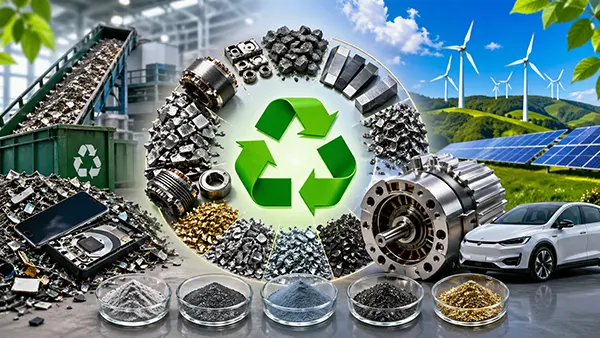
Recycling Rare Earth Metals: Why It Has Become a Strategic Priority
Rare earth metals underpin modern technologies, from electric vehicles to advanced defence systems. Yet their extraction is complex, environmentally demanding, and heavily concentrated in a few regions. By 2026, recycling these materials is no longer a niche industrial practice but a strategic necessity tied to economic resilience, environmental responsibility, and geopolitical stability.
The Growing Dependence on Rare Earth Elements
Rare earth elements (REEs) are essential components in high-performance magnets, batteries, wind turbines, and semiconductor devices. Despite their name, these elements are relatively abundant in the Earth’s crust, but economically viable deposits are scarce and difficult to process. As industries accelerate electrification and digitalisation, demand continues to outpace traditional mining capacity.
China currently dominates global rare earth supply chains, accounting for a significant share of mining and refining capacity. This concentration creates vulnerabilities for other regions, particularly Europe and North America, which rely heavily on imports. Supply disruptions—whether due to political tensions or environmental restrictions—can directly affect manufacturing sectors and innovation cycles.
Recycling offers a practical pathway to reduce this dependence. By recovering rare earths from end-of-life electronics, electric motors, and industrial waste, countries can establish secondary supply streams. This not only improves resource security but also aligns with circular economy principles increasingly prioritised in industrial policy.
Where Rare Earth Metals Are Found in Everyday Technologies
Modern consumer electronics contain small but valuable quantities of rare earth metals. Smartphones, for instance, rely on neodymium magnets for speakers and vibration systems, while screens may include europium and yttrium for colour display. Although individual devices contain minimal amounts, their global volume makes them a significant secondary resource.
Electric vehicles represent another major source. Permanent magnet motors use neodymium, dysprosium, and praseodymium to achieve high efficiency and compact design. As the first generation of EVs reaches end-of-life, recycling these components becomes both economically viable and strategically important.
Industrial equipment, including wind turbines and aerospace systems, also contains rare earth-based alloys and magnets. These applications involve higher concentrations, making them particularly attractive targets for recycling technologies that can recover materials at scale.
Technological Challenges in Rare Earth Recycling
Recycling rare earth metals is significantly more complex than recycling common materials like aluminium or steel. These elements are often embedded in composite structures, bonded with other metals, or dispersed in tiny quantities across components. Efficient separation requires advanced chemical and physical processes.
Hydrometallurgical techniques, which use aqueous chemistry to dissolve and separate metals, remain the most widely used approach. However, they involve multiple stages, generate waste streams, and require careful management to minimise environmental impact. Pyrometallurgical methods, based on high-temperature processing, are less selective and can result in material losses.
Emerging technologies aim to address these limitations. Direct recycling methods focus on preserving the structure of magnets and alloys rather than breaking them down completely. This reduces energy consumption and improves material recovery rates, making the process more economically viable.
Innovations Driving Efficiency and Scalability
Recent advancements include the use of bioleaching, where microorganisms help extract rare earth elements from waste materials. This approach operates under milder conditions compared to traditional methods and reduces the need for aggressive chemicals. While still under development, it shows potential for industrial-scale applications.
Automation and AI-driven sorting systems are also transforming the recycling process. By identifying and separating components containing rare earth metals with high precision, these systems improve recovery rates and reduce manual labour. This is particularly important given the complexity of modern electronic waste streams.
Another promising area is solvent extraction optimisation, where new chemical formulations enhance selectivity and reduce environmental impact. Combined with closed-loop systems, these innovations support more sustainable recycling practices while maintaining economic feasibility.

Strategic and Environmental Implications
The strategic importance of rare earth recycling extends beyond supply security. It plays a critical role in reducing the environmental footprint of mining activities, which often involve significant land disruption, water use, and chemical pollution. Recycling reduces the need for primary extraction and mitigates these impacts.
Governments are increasingly recognising this potential. The European Union’s Critical Raw Materials Act and similar initiatives in the United States and Japan emphasise the development of domestic recycling capabilities. These policies aim to create resilient supply chains while supporting green transition goals.
From an economic perspective, recycling also creates new industrial opportunities. Companies specialising in material recovery, waste processing, and advanced metallurgy are gaining strategic importance. This shift is reshaping the value chain, placing greater emphasis on resource efficiency and technological innovation.
Why Recycling Rare Earths Is Becoming a Global Priority
Geopolitical considerations are a major driver. As access to raw materials becomes more contested, countries seek to reduce reliance on external suppliers. Recycling provides a controlled, domestic source of critical materials, enhancing national security and industrial independence.
Environmental regulations are another factor. Stricter standards for mining and waste management increase the cost of primary extraction, making recycling comparatively more attractive. At the same time, public awareness of sustainability issues encourages companies to adopt circular practices.
By 2026, rare earth recycling is no longer optional for advanced economies. It is an integral part of industrial strategy, combining technological innovation, environmental responsibility, and geopolitical foresight. As demand continues to grow, the ability to recover and reuse these materials will define the resilience of future supply chains.